
Hosted by the Center for Latin American Studies at the University of Pittsburgh and the Political Institutions and Processes Section of the Latin American Studies Association. This is a virtual series to create a space for political scientists and other academics to discuss the critical social and political challenges facing Latin America today--including democratic backsliding, economic inequality, racial injustice, gender inequities, and a host of other issues. Please see this letter for more information on the series and about how to get involved. For questions, please email charlemos@pitt.edu
See our YouTube Playlist of past talks!
Past Events
Charlemos! The Deepening of Autocracy in Venezuela
Presenters:
Javier Corrales (Amherst College), Antulio Rosales (Oxford University), Dorothy Kronick (University of California - Berkeley), John Polga-Hecimovich (U.S. Naval Academy) and Raúl Sánchez-Urribarri (La Trobe University)
Date:
Friday, September 13, 2024 - 15:00
Join us for a conversation on the autocracy movements in Venezuela. The panel is joined by Dorothy Kronick (University of California, Berkeley), "On the validity of vote counts published by the Venezuelan opposition", Antulio Rosales (Oxford University), "Unprecedented Fraud and New Momentum: What is Different This Time in Venezuela" and John Polga-Hecimovich (U.S. Naval Academy) and Raúl Sánchez-Urribarri (La Trobe University), "Authoritarian Consolidation in Times of Crisis: Venezuela under Nicolás Maduro (forthcoming edited volume)".
Moderated by Javier Corrales (Amherst College).

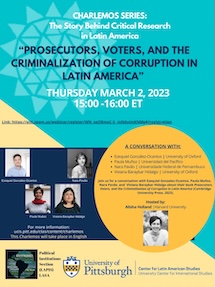
Charlemos! "Prosecutors, Voters, and The Criminalization of Corruption in Latin America"
Presenters:
Date:
Join us for a conversation with Ezequiel González-Ocantos (University of Oxford), Paula Muñoz (Universidad del Pacífico), Nara Pavão (Universidade Federal de Pernambuco), and Viviana Baraybar Hidalgo (University of Oxford) about their book Prosecutors, Voters, and the Criminalization of Corruption in Latin America (Cambridge University Press, 2023). Hosted by Alisha Holland (Harvard University).
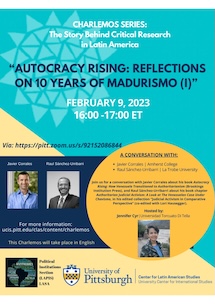
Charlemos! Autocracy Rising: Reflections
Presenters:
Date:
Join us for a conversation with Javier Corrales (Amherst College) about his book Autocracy Rising: How Venezuela Transitioned to Authoritarianism (Brookings Institution Press), and Raul Sánchez-Urribarri (La Trobe University) about his book chapter Authoritarian Judicial Activism: A Look at The Venezuelan Case Under Chavismo, in his edited collection "Judicial Activism in Comparative Perspective" (co-edited with Lori Hausegger). Hosted by Jenifer Cyr (Universidad Tocuato Di Tella)
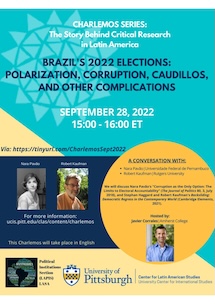
Charlemos! Brazil's 2022 Election: Polarization, Corruption, Caudillos, and Other Complications
Presenters:
Date:
Discussion on Nara Pavão's "Corruption as the Only Option: The Limits to Electoral Accountability" (The Journal of Politics 80, 3, July 2018), and Stephan Haggard and Robert Kaufman's Backsliding: Democratic Regress in the Contemporary World (Cambridge Elements, 2021)
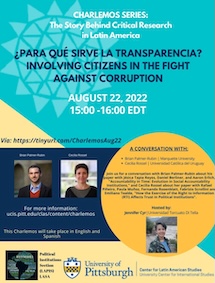
Charlemos! Para Qué Sirve la Transparencia? Involving Citizens in the Fight Against Corruption
Presenters:
Date:
Monday, August 22, 2022 - 15:00
Join us for a conversation with Brian Palmer-Rubin about his paper with Jésica Tapia Reyes, Daniel Berliner, and Aaron Erlich, "Accountability in Time: Evolution in Social Accountability Institutions," and Cecilia Rossel about her paper with Rafael Piñeiro, Paula Muñoz, Fernando Rosenblatt, Fabrizio Scrollini and Emiliano Tealde, "How the Exercise of the Right to Information (RTI) Affects Trusts in Political Institutions." Hosted by Jennifer Cyr (Universidad Torcuato Di Tella). This Charlemos will take pace in English and Spanish.
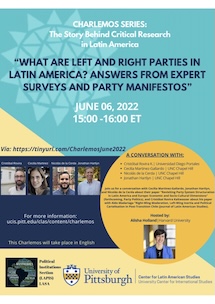
Charlemos! What are Left and Right Parties in Latin America? Answers from Expert Surveys and Party Manifestos
Presenters:
Cristobal Rovira K., (Universidad Diego Portales), Cecilia Martinez-Gallardo (UNC Chapel Hill), Nicolas de la Cerda (UNC Chapel Hill), Jonathan Hartlyn (UNC Chapel Hill)
Date:
Monday, June 6, 2022 - 15:00
Join us for a conversation with Cecilia Martinez-Gallardo, Jonathan Hartlyn, and Nicolás de la Cerda about their paper "Revisiting Party System Structuration in Latin America and Europe: Economic and Socio-Cultural Dimensions" (forthcoming, Party Politics), and Cristóbal Rovira Kaltwasser about his paper with Aldo Madariaga "Right-Wing Moderation, Left-Wing Inteia and Political Cartelisation in Post-Transition Chile (Journal of Latin American Studies).
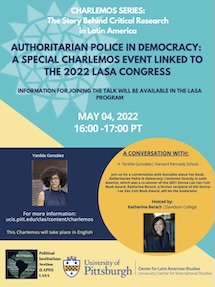
Authoritarian Police in Democracy
Presenters:
Date:
Join us for a conversation with González about her book, Authoritarian Police in Democracy: Contested Security in Latin America, which was a co-winner of the 2021 Donna Lee Van Cott Book Award. Katherine Bersch, a former recipient of the Donna Lee Van Cott Book Award, will be the moderator. Note: This episode of Charlemos is only accessible through the LASA Congress.
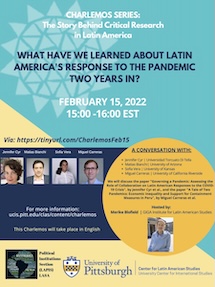
What have we learned about Latin America's response to the pandemic two years in?
Presenters:
Date:
We will discuss the paper "Governing a Pandemic: Assessing the Role of Collaboration on Latin American Responses to the COVID-19 Crisis," by Jennifer Cyr et al., and the paper "A Tale of Two Pandemics: Economic Inequality and Support for Containment Measures in Peru," by Miguel Carreras et al.
Storming Democracy: Competitive Authoritarianism in Central America
Presenters:
Date:
This Charlemos discussed the report "Informe: Sexto Estado de la Región 2021" by Jorge Vargas Cullell et al., the paper "Latin America Erupts: Millennial Authoritarianism in El Salvador" by Manuel Meléndez-Sánchez, and the book Understanding Central America: Global Forces and Political Change, by John Booth, Christine Wade and Thomas Walker.

Cuba: Régimen Político y Protesta Social ¿El Fin de Una Excepcionalidad Regional?
Presenters:
Date:
La discusión se basará en el artículo de Armando Chaguaceda "El destino de Sísifo. Régimen político y nueva Constitución en Cuba", y en el libro de Silvia Pedraza y Carlos Romero "Revolutions in Cuba and Venezuela: One Hope Two Realities" (próxima publicación). La charla será en español.

The Limits of Judicialization: From Progress to Backlash in Latin American Politics
Presenters:
Date:
We will discuss the chapter "Working in new political spaces: the checkered history of Latin American judicialization," from the book Working in new political spaces: the checkered history of Latin American judicialization edited by Sandra Botero, Daniel Brinks, and Ezequiel González-Ocantos. The conversation will be moderated by Raúl Sánchez Urribarri in English.

Estrategias de oposición a los procesos autocráticos
Presenters:
Date:
The discussion will be based on the articles "Contesting Autocracy: Repression and Opposition Coordination in Venezuela" by Maryhen Jiménez (University of Oxford) and "Opposition at the Margins: Strategies against the Erosion of Democracy in Colombia and Venezuela" by Laura Gamboa (University of Utah). The conversation will be moderated by Raúl Sánchez Urribarrí (La Trobe University) in Spanish.
La discusión se basará en el artículo de Maryhen Jiménez (University of Oxford) "Contesting Autocracy: Repression and Opposition Coordination in Venezuela" y en el artículo de Laura Gamboa (University of Utah). "Opposition at the Margins: Strategies against the Erosion of Democracy in Colombia and Venezuela." La conversación será moderada por Raúl Sánchez Urribarrí (La Trobe University) en español.

Changes in Black Politics in Latin America
Presenters:
Date:
In this edition of Charlemos, we discussed Kwame Dixon's (Howard University) article, "Afro-Latin Social Movements in Latin America and the Caribbean" (in Politics, 2020) and David De Micheli's (University of Utah) article, "Racial Reclassification and Political Identity Formation” (in World Politics 2020). The conversation was moderated by Alisha Holland (Harvard University).

Elecciones en el Perú: ¿Qué ha pasado? ¿Qué se viene?
Presenters:
Date:
El tema del decimocuarto Charlemos era las Elecciones en el Perú: ¿Qué ha pasado? ¿Qué se viene? La discusión se basó en el artículo de Julio F. Carrión (University of Delaware), "Takeoff and Turbulence in Modernizing Peru," y el artículo de José Incio (University of Pittsburgh) y Moises Arce, "Perú 2017: Un caso extremo de gobierno dividido." La conversación fue moderada por Jennifer Cyr.
Artícuos disponibles aquí:

Radical versus Moderate Voters in Latin America
Presenters:
Date:
The topic of discussion for the thirteenth Charlemos was "Radical versus Moderate Voters in Latin America." Andrés Mejía Acosta (King's College London) moderated a conversation with Juan A. Moraes (Universidad de la República), Diego Luján (Universidad de la República), and Lucio Rennó. The discussion was based on "The Electoral Success of the Left in Latin America: Is There Any Room for Spatial Models of Voting" (published in LARR), by Juan A. Moraes and Diego Luján, and "The Bolsonaro Voter: Issue Positions and Vote Choice in the 2018 Brazilian Presidential Elections" (published in LAPS), by Lucio Rennó.
Readings available here:


Avanzando hacia atrás? Elecciones y democracia en Ecuador
Presenters:
Date:
La duodécima conferencia de Charlemos enfocó en el tema de las elecciones en Ecuador. Andrés Mejía Acosta (King's College London) moderaró una conversación entre John Polga-Hecimovich (U.S. Naval Academy) y Diana Dávila Gordillo (University of Leiden). John Polga-Hecimovich habló de su artículo (forthcoming), "Old Habits Die Hard: Ecuador's Return to Political Instablity" (escrito con Francisco Sánchez) que se publicará en Journal of Democracy en junio. Diana Dávila Gordillo habló de su texto, "Pachakutik, the Indigenous Voters, and Segmented Mobilisation Strategies."
The topic of discussion for the twelfth Charlemos was "Progressing Backwards? Elections and Democracy in Ecuador." Andrés Mejía Acosta (King's College London) moderated a conversation between John Polga-Hecimovich (U.S. Naval Academy) y Diana Dávila Gordillo (University of Leiden). John Polga-Hecimovich discussed his forthcoming article, "Old Habits Die Hard: Ecuador's Return to Political Instablity, " (co-written with Francisco Sánchez) which will be published in June in the Journal of Democracy. Diana Dávila Gordillo discussed her text, "Pachakutik, the Indigenous Voters, and Segmented Mobilisation Strategies."
Lecturas disponibles aquí // Readings available here:
- Draft - Pachakutik, the Indigenous Voters, and Segmented Mobilisation Strategies (Dávila Gordillo 2021)
- Draft - Do not cite The Persistence of Old Habits: Ecuador's Return to Political Instability (Polga-Hecimovich & Sánchez 2021)


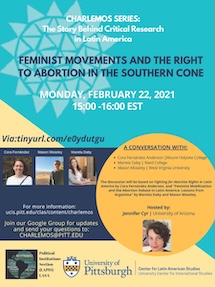
Movimientos Feministas y Derechos Reproductivos en el Cono Sur
Presenters:
Date:
La undécima conferencia de Charlemos enfocó en el tema de "Movimientos Feministas y Derechos Reproductivos en el Cono Sur." Jennifer Cyr (University of Arizona) moderó la conversación entre Cora Fernández Anderson (Mount Holyoke College) quien habló de su nuevo libro, Fighting for Abortion Rights in Latin America: Social Movements, State Allies, and Institutions y Mariela Daby (Reed College) y Mason Moseley (West Virginia University) quienes hablaron de su artículo, "Feminist Mobilization and the Abortion Debate in Latin America: Lessons from Argentina," publicado en Politics & Gender.
The eleventh Charlemos focused on the topic of "Feminist Movements and Reproductive Rights in the Southern Cone." Jennifer Cyr (University of Arizona) moderated the conversation between Cora Fernández Anderson (Mount Holyoke College), who talked about her new book, Fighting for Abortion Rights in Latin America: Social Movements, State Allies, and Institutions and Mariela Daby (Reed College) and Mason Moseley (West Virginia University) who discussed their new article, "Feminist Mobilization and the Abortion Debate in Latin America: Lessons from Argentina," published in Politics & Gender.
Lecturas disponibles aquí // Readings available here:

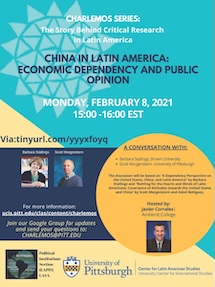
China in Latin America: Economic Dependency and Public Opinion
Presenters:
Date:
The tenth Charlemos focused on the topic of "China in Latin America: Economic Dependency and Public Opinion". Barbara Stallings (Brown University) discussed her paper, "A Dependency Perspective on the United States, China, and Latin America" and Scott Morgenstern (University of Pittsburgh) discussed his forthcoming paper (co-authored with Asbel Bohigues, University of Salamanca), "Battling for the Hearts and Minds of Latin Americans: Covariance of Attitudes Towards the United States and China." Javier Corrales (Amherst College) moderated the discussion.
Papers are available to read here:
- Stallings, 2021 (Summary of chapter in: Madariaga & Palestini, eds. Dependent Capitalisms in Contemporary Latin America and Europe, Palgrave Macmillan).
- Morgenstern & Bohigues, 2021 (Forthcoming in Latin American Research Review).

Venezuela: Political Conflict and Economic Collapse
Presenters:
Date:
The ninth Charlemos focused on the Special Edition Issue of America Latina Hoy, "Venezuela: Political Conflict and Economic Collapse". We talked with the editors and authors: José Manuel Puente, Susanne Gratius, and the director of the journal, María Ángeles Huete Garcia. Benedicte Bull (University of Oslo) moderated the conversation.
Access the Special Issue of America Latina Hoy.

International Organizations and Democracy Promotion in Latin America
Presenters:
Date:
In the eighth Charlemos, Scott Morgenstern (University of Pittsburgh) moderated a discussion between Jennifer McCoy (Georgia State University) and Stefano Palestini (Pontificia Universidad Católica de Chile). The discussion was based on Thomas Legler and Jennifer McCoy's, "Games People Play: International Regime and the Venezuelan Political Crisis," presented at LASA 2016 and Stefano Palestini's, "Regional Organizations and the Politics of Sanctions Against Undemocratic Behaviour in the Americas," published in International Political Science Review, 2020.


Populism in the Americas
Presenters:
Date:
In the seventh Charlemos, Victoria Murillo (Columbia University) moderated a discussion between Kurt Weyland (University of Texas at Austin) and Steven Levitsky (Harvard University) on the topic of "Populism in the Americas". They delved into comparisons between Trumpism and Populism in Latin America


Amenazas hacia la democracia en Colombia
Presenters:
Date:
La sexta conferencia de Charlemos estuvo copatrocinado por el Departamento de Ciencia Política de la Universidad de los Andes. Raul Sánchez-Urribarri (Universidad de La Trobe, Melbourne, Australia) moderó la discusión entre Angelika Rettberg (Universidad de Los Andes), Sandra Botero (Universidad del Rosario), y Laura Gamboa (Universidad de Utah) acerca del tema "Amenazas hacia la democracia en Colombia". Angelika Rettberg habló de su artículo "Colombia en 2019: La paradoja de la abundancia"; Sandra Botero y Laura Gamboa hablaron de su artículo "Corte al Congreso: Poder judicial y trámite legislativo en Colombia".
The sixth Charlemos was co-sponsored by the Department of Political Science at the University of the Andes. Raul Sánchez-Urribarri (La Trobe University, Melbourne, Australia) moderated the discussion with Angelika Rettberg (Universidad de los Andes), Sandra Botero (Universidad del Rosario), and Laura Gamboa (University of Utah) on "Threats to Democracy in Colombia". Angelika Rettberg discussed her article, "Colombia in 2019: The Paradox of Plenty"; Sandra Botero and Laura Gamboa discussed their article, "From Court to Congress: Judicial Power and Legislative Procedure in Colombia."
Los artículos están dsiponsibles aquí: // Articles available here: Colombia en 2019/Colombia in 2019 and Corte al Congreso/From Court to Congress.


Votes, Drugs, and Violence: Mexico and Beyond
Presenters:
Date:
In the fifth Charlemos, Fabrice Lehoucq (University of North Carolina, Greensboro) moderated a discussion with Sandra Ley (CIDE) and Guillermo Trejo (University of Notre Dame) on "Votes, Drugs, and Violence: Mexico and Beyond". We discussed their book Votes, Drugs, and Violence: The Political Logic of Criminal Wars in Mexico (Cambridge University Press, August 2020). Book description from Cambridge University Press:
One of the most surprising developments in Mexico's transition to democracy is the outbreak of criminal wars and large-scale criminal violence. Why did Mexican cartels go to war as the country transitioned away from one-party rule? And why have criminal wars proliferated as democracy has consolidated and elections have become more competitive subnationally? In Votes, Drugs, and Violence, Guillermo Trejo and Sandra Ley develop a political theory of criminal violence in weak democracies that elucidates how democratic politics and the fragmentation of power fundamentally shape cartels' incentives for war and peace. Drawing on in-depth case studies and statistical analysis spanning more than two decades of multiple levels of government, Trejo and Ley show that electoral competitiion and partisan conflict were key drivers of the outbreak of Mexico's crime wars, the intensification of violence, and the expansion of war and violence to the spheres of local politics and civil society.


Religion, Sexuality Politics, and Voting Behavior in Latin America
Presenters:
Date:
In the fourth Charlemos, Javier Corrales (Amherst College) moderated a conversation with Amy Erica Smith (Iowa State University) and Taylor C. Boas (Boston University) on "Religion, Sexuality Politics, and Voting Behavior in Latin America". The talk was based on a paper by the same title that was written for the 2020 APSA. See the abstract and link to the paper below:
Right wing candidates have rallied against same-sex marriage, abortion, and "gender ideology" in several recent Latin American elections, drawing strong support from socially conservative voters. Yet in other parts of the region, these issues are largely irrelevant to voting decisions. Drawing on theories explaining partisan shifts in the United States, we argue that elite debates on sexuality politics create conditions for electoral realignment in Latin America. When politicians take polarized positions on newly salient "culture war" issues, masses shift their voting behavior. Using a conjoint experiment in Brazil, Chile, and Peru and region-wide multilevel analysis of the AmericasBarometer and Latinobarómetro, we demonstrate that the rising salience of sexuality politics creates new electoral cleavages in terms of issue attitudes and religion. Whereas scholarship in the United States posits the centrality of partisanship, our findings indicate that sexuality politics prompts realignments even in weak party systems.


La reforma constitucional chilena en perspectiva comparada
Presenters:
Date:
En la tercera conferencia de la serie Charlemos, Julieta Suárez-Cao (Pontificia Universidad Católica de Chile, #reddepolitólogas) moderó la discusión con Claudia Heiss (Universidad de Chile, #reddepolitólogas) y Gabriel L. Negretto (Pontificia Universidad Católica de Chile) sobre "La reforma constitucional chilena en perspectiva comparada."
The third lecture of the series focused on constitutional reform in Chile. Julieta Suárez-Cao (Pontifical Catholic University of Chile, #reddepolitólogas) led the discussion with Claudia Heiss (University of Chile, #reddepolitólogas) and Gabriel L. Negretto (Pontifical Catholic University of Chile).
- Claudia Heiss, 2020. "Emergencia y proceso constituyente: la frágil construcción de una salida democrática al choque de legitimidades" (Forthcoming en el libro: Contreras, Pablo (ed.), La ley de la emergencia. Ensayos sobre el derecho, la excepción y la pandemia. Santiago: Der Ediciones.) Trabajo disponible aquí.
- Gabriel L. Negretto, 2020. "New Constitutions in Democratic Regimes" (Forthcoming en el libro: Negretto, Gabriel L (ed.), Redrafting Constitutions in Democratic Regimes: Theoretical and Comparative Perspectives. Cambridge: Cambridge University Press.)

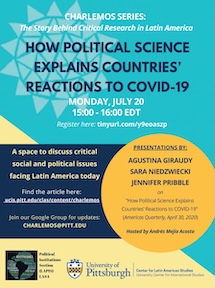
Presenters:
Date:
The second lecture of the series focused on "How Political Science Explains Countries’ Reactions to COVID-19." Andrés Mejía Acosta moderated and Agustina Giraudy, Sara Niedzwiecki, and Jennifer Pribble discussed their recent article, published in America's Quarterly.
El artículo en español. / O artigo em Português. / The article in English.

Inconsistent Backsliding in Latin America
Presenters:
Date:
The first lecture of the series focused on "Inconsistent Backsliding in Latin America." Jennifer Cyr moderated and Javier Corrales discussed his recently published paper and Fabrice Lehouqc discussed his forthcoming paper.
- Javier Corrales, 2020. "Democratic backsliding through electoral irregularities: The case of Venezuela." European Review of Latin American and Caribbean Studies. Abstract available here.
- Fabrice Lehoucq, forthcoming. "Bolivia's Citizen Revolt." Journal of Democracy.

